

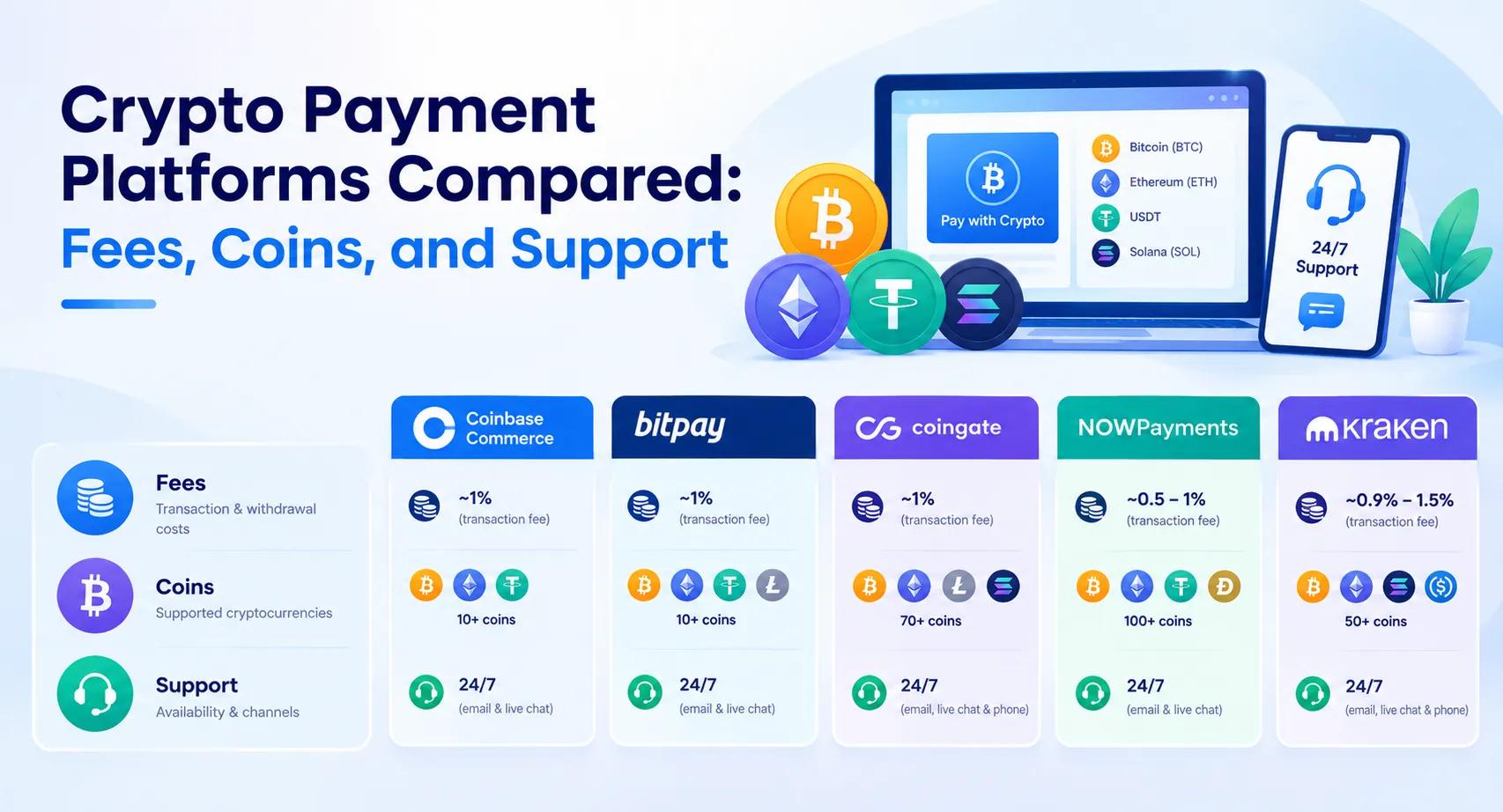
crypto payment plateform compared
Picking a crypto payment platform looks easy until you open five pricing pages and find five ways to describe a fee. One says 0.5%. Another says 1% plus network costs. A third puts the withdrawal charge in a footnote. This guide covers Crypto payment platforms compared: fees, coins, and support, so you can compare providers on the same terms. I won't rank brand names, because prices and features change often. I'll show you what to check and how to score it.
The short answer
Compare three things first. The total cost per payment, the coins and networks you can accept, and how the provider treats you when a payment goes wrong. For most online merchants, a custodial gateway with stablecoin support and a responsive support desk is the safest start. Technical teams that want control often prefer non-custodial or self-hosted tools. That is Crypto payment platforms compared: fees, coins, and support in brief. The sections below take each part in turn.
The four kinds of platform
Not all platforms do the same job, so compare like with like.
Custodial gateways receive the payment, hold it, and pay you out in crypto or fiat. Setup is easy and conversion is built in. You trust the provider with your funds until payout.
Non-custodial gateways send payments straight to a wallet you control. You keep the keys and the responsibility.
Self-hosted software runs on your own server. BTCPay Server is a well-known open-source example. The software is free, but you handle hosting, updates, and security.
Exchange-linked merchant tools sit inside a large exchange. They suit people who already trade there, though they may limit coins, regions, or account features.
A small shop with no developer usually lands in the first group. A team with a sysadmin and strong views on custody may prefer the third.
Fees
Fees are where Crypto payment platforms compared: fees, coins, and support gets confusing, so build a real cost instead of trusting the headline rate. Many gateways charge roughly 0.5% to 1% per transaction. Then hunt for the extras.
Network fees paid to the blockchain, sometimes passed to you or the customer
Conversion spread when the platform turns crypto into fiat
Payout or withdrawal fees, often a fixed amount
Monthly or setup fees
Refund fees
Minimum payment or minimum payout limits
Here is an example with made-up round numbers. You sell 10,000 dollars a month. A 1% platform fee is 100. A 0.5% conversion spread is 50. Two bank payouts at 5 dollars each is 10. The total is 160, or 1.6%. The "1% platform" cost you 60% more than it claimed.
For context, US card processing is commonly quoted around 2.9% plus a fixed fee per sale, and higher for international cards. Crypto can still come out cheaper, but only if you count everything.
Coins and networks
Bitcoin and Ethereum are the baseline. The network matters more than the coin. USDT, for example, runs on several chains, and the cost to send it ranges from a few cents to several dollars depending on the chain. That difference lands on your customer at checkout.
When you review Crypto payment platforms compared: fees, coins, and support, check these coin points.
Stablecoin support, so a 100 dollar order stays a 100 dollar order
Which networks each coin runs on, and whether cheap ones are included
Lightning support, if you want small Bitcoin payments
Handling of coins that need a memo or destination tag, like XRP
Whether you can switch coins off, so customers don't pay in something you can't use
More isn't better. A platform listing 300 coins has 300 sources of wrong-network mistakes and support tickets. Ask your own customers what they hold, then choose the platform that covers those coins well.
Support
Nobody checks support until a payment goes missing, and by then it's late. Crypto payment platforms compared: fees, coins, and support falls apart if the support half is a contact form and silence. Most missing payments aren't lost. They're late, short, or sent on the wrong network. Support decides how those cases end.
Look for these signs.
Named channels, such as live chat or email that a person reads
Ticket numbers, so you can track a case
Agents who read a blockchain explorer and ask for the transaction hash
A written policy on underpayments, overpayments, expired invoices, and wrong-network deposits
Clear rules on whether recovery is offered and what it costs
A status page for outages and network delays
Documentation that answers real questions
Run a quick test. Send a pre-sales message with a technical question, like "What happens if a customer pays after the invoice expires?" A specific answer within a day is a good sign. A generic reply, or nothing, tells you how a real problem will go.
A simple scorecard
Numbers beat gut feeling when three people need to agree on a provider. Score each platform from 1 to 5 on the categories below, then multiply by a weight.
Total cost, weighted 30%
Coins and networks, 20%
Support quality, 25%
Integration, meaning plugins, API, and webhooks, 15%
Security and compliance, 10%
Change the weights to fit your business. An agency invoicing overseas clients cares most about cost and payout speed. A store selling digital goods cares more about integration and support. Use this method to turn Crypto payment platforms compared: fees, coins, and support into a number you can defend to a partner or an accountant.
Security deserves a quick check inside that last category. Look for two-factor login, payout address whitelisting, and signed webhooks. Ask whether the provider screens transactions for sanctioned funds. A provider that shrugs at compliance can cause trouble for you too.
Where FaradPay fits
FaradPay is a crypto payment provider, so run it through the same scorecard. Pull its fee list, supported coins and networks, payout options, and support channels, then score it next to two other providers. Don't rely on my summary, or anyone's. Your own numbers are the fair way to handle Crypto payment platforms compared: fees, coins, and support.
FAQ on Crypto payment platforms compared: fees, coins, and support
What is the cheapest crypto payment platform?
There isn't one answer. Self-hosted software has no platform fee but costs you hosting and time. Hosted gateways usually charge around 0.5% to 1% plus extras. Add up every fee before you decide.
Which coins should a platform support?
At minimum, Bitcoin, Ethereum, and a stablecoin such as USDT or USDC on a low-cost network. Add others only if your customers ask.
Custodial or non-custodial, which is better?
Custodial is simpler and handles conversion. Non-custodial gives you control but also the risk. Small merchants often start custodial. Technical teams often choose non-custodial.
How can I test a platform's customer support?
Send a specific technical question before you sign up and time the answer. Also read the terms for underpayments, wrong-network deposits, and refunds.
Do I have to hold crypto?
No. Many platforms convert payments to fiat or stablecoins automatically, which removes most price risk.
Are crypto payments cheaper than cards?
Often, but not always. Count network fees, conversion spread, and payout fees. Compare the total, not the headline rate.
Can I use more than one platform?
Yes. Some merchants run a second provider as a backup or to cover coins the first one lacks.
Final thoughts
The best platform is the one that fits your customers and your team, and that will be different for every store. Add up the true cost, match the coins to your buyers, and test support before you need it. Do that, and Crypto payment platforms compared: fees, coins, and support stops being a marketing puzzle and becomes a short decision you can make in an afternoon.